
Days before Diwali, the monthly economic review by the finance ministry has highlighted moderation in urban demand, softening consumer sentiments and limited footfall as areas that need to be watched. In its review, released on Monday, the ministry also noted the early signs of artificial intelligence displacing workers, as described in anecdotal reports. The commentary from several large consumer goods companies, including Nestl India, Hindustan Unilever, and ITC, in their recent quarterly earnings, has been around a sluggish urban demand. Rural consumption, however, has mostly seen a revival, the companies pointed out.

S&P Global Ratings on Wednesday said the impact of the US reciprocal tariff will be limited on India as the economy is domestically oriented with less reliance on exports. YeeFarn Phua, Director, Sovereigns and International Public Finance Ratings, Asia-Pacific S&P Global also said India will clock a 6.7-6.8 per cent GDP growth over the next two years.

IT services firm Wipro's revenue is likely to increase by about 4.5 per cent in FY26, mainly driven by favourable sectoral trends and recovery in discretionary customer spending, according to global rating agency Fitch.

Macroeconomic data announcements, trading activity of foreign investors and global trends will guide equity market movement this week, which would also mark the beginning of the new calendar year and month, analysts said.

'My life has been quite difficult. I felt I could see it in words. I thought if everyone else can write, then I can too.'
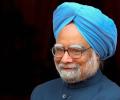
Former Prime Minister Manmohan Singh's 1991 budget unshackled India's economy, significantly enhancing the economic prospects for hundreds of millions of Indians, first deputy managing director of the International Monetary Fund (IMF) Gita Gopinath said on Friday.

The Indian economy is recovering from the slowdown in momentum witnessed in the September quarter, driven by strong festival activity and a sustained upswing in rural demand, according to a Reserve Bank of India (RBI) bulletin released on Tuesday. An article on the 'State of the Economy' in the December bulletin noted that the global economy continues to exhibit resilience with steady growth and moderating inflation.
Against the Reserve Bank of India's (RBI's) projection of 7.1 per cent, India's first quarter (Q1) 2024-25 (FY25) gross domestic product (GDP) growth came in at 6.7 per cent. This is in line with market expectations and significantly lower than the 7.8 per cent recorded in the fourth quarter (Q4) 2023-24 (FY24) and 8.2 per cent in Q1FY24. The quarter witnessed decreased government consumption and investment spending due to the parliamentary election.

'Stay disciplined, and remain invested.' 'Volatile times are the best to invest in structural opportunities at the right price.'

S&P Global Ratings on Tuesday said the Indian economy is set for "resilient growth" in 2025 and projected inflation pressure to recede which will lead to "modest" easing of the monetary policy by the RBI. In its India outlook for 2025, S&P also retained India's growth forecast for current fiscal at 6.8 per cent, followed by 6.9 per cent growth in 2025-26.

Passenger vehicle wholesales in India rose 9 per cent year-on-year in August on the back of strong demand for utility models, industry body SIAM said on Monday. Overall passenger vehicle dispatches to dealers rose to 359,228 units last month from 328,376 units in August 2022. Utility vehicle sales increased 34 per cent year-on-year to 181,825 units.

The improved outlook on the Government of India announced by rating agency Moody's might need to be viewed with some scepticism. There is no doubt the performance of the Indian economy has sharply improved from the deep trough it hit last year. But the ability of the second largest global ratings agency to assess an upside and downside before events make everyone wise about India has been dismal for a long time, as the chart shows.

"The fundamental credit outlook for the Indian banking system remains negative, reflecting the currently challenging economic conditions and the rising level of problem loans," Moody's said in a report.

As India faces slowing economic growth, HSBC Global Research has downgraded the Indian stock market outlook from "overweight" to "neutral". In a report, the global financial services firm said profits at India Inc appeared to have softened while valuations are elevated. After annualized growth of 25 per cent in recent years, profits appear to have softened while valuations are elevated at 23x forward earnings.

IT company Wipro on Wednesday reported almost flat growth in consolidated net profit at Rs 2,667.3 crore for the September 2023 quarter and projected a 3.5 per cent fall in revenue in the current quarter on a weak global economic outlook. The company had posted a profit after tax of Rs 2,649.1 crore a year ago. Its lower IT services growth estimate for the December 2023 quarter by 3.5-1.5 per cent is in the range of $2,617-2,672 million in constant currency terms or about Rs 21,642.59 -- Rs 22,097.44 crore.

Acutely conscious that he's left with less than four years to create his legacy, Trump is undoubtedly a man in a hurry, observes Ambassador M K Bhadrakumar.

The encouraging news, however, is that India features among the top four countries out of 44 nations that projected a positive hiring trend.

The Indian economy is expected to be "a little weaker" in 2025 despite steady global growth, IMF managing director Kristalina Georgieva has said. Georgieva also said she expects quite a lot of uncertainty in the world this year mainly around the trade policy of the US. In her annual media roundtable with a group of reporters on Friday, she said global growth is expected to be steady in 2025, but with regional divergence.

Global trends, macroeconomic data, and the outcome of the US Fed policy meeting are the major factors that will drive the movement in the domestic equity markets this week, analysts said. "In the upcoming data-centric week, the focus will be on crucial releases, including inflation data from India and the US. "Indian inflation is expected to rise, while US inflation will remain steady.

India, the world's fifth largest economy in the world, is likely to overtake Japan to become the world's third-largest economy with a GDP of $7.3 trillion by 2030, S&P Global Market Intelligence said in its latest issue of PMI. After two years of rapid economic growth in 2021 and 2022, the Indian economy has continued to show sustained strong growth during the 2023 calendar year. India's gross domestic product (GDP) is expected to grow 6.2-6.3 per cent in the fiscal year ending in March 2024, being the fastest-growing major economy this fiscal year.

The International Monetary Fund (IMF) on Tuesday said it is expecting some slowdown in the Indian economy next fiscal year and projected the growth to 6.1 per cent from 6.8 per cent during the current fiscal ending March 31. The IMF on Tuesday released the January update of its World Economic Outlook, according to which the global growth is projected to fall from an estimated 3.4 per cent in 2022 to 2.9 per cent in 2023, then rise to 3.1 per cent in 2024. "Our growth projections actually for India are unchanged from our October Outlook.

Inflation has remained a major concern.

Domestic rating agency Icra on Wednesday said India's real GDP growth for the September quarter is likely to decline to 6.5 per cent due to heavy rains and weaker corporate performance. The agency, however, maintained its FY25 growth estimate at 7 per cent on expectations of a pick up in economic activity in the second half of the fiscal.

Indian economy's growth is expected to be "below trend" even as neighbouring China and most of the developed nations are expected to see better prospects, according to Paris-based think tank OECD.

The trigger for international gold prices rising to $3,000 per ounce was Germany's upcoming heavy government borrowing.

Crisil Ratings on Wednesday said a broad-based recovery is on for India Inc currently, and upgraded its credit quality outlook to 'positive' from the earlier 'cautiously optimistic'. The rating agency said the credit ratio, which illustrates the number of upgrades to downgrades, rose to over 2.5 times in the first four months of the fiscal, as compared to 1.33 times in the second half of FY21, it said in a statement. The rating agency said it has also done a study of 43 sectors, excluding the financial sector, accounting for 75 per cent of the overall Rs 36 lakh crore in outstanding debt, which shows that the current recovery is broad-based.

RBI's interest rate decision, quarterly earnings and global cues would be the major driving factors for equity markets this week, analysts said adding that the impact of the Union Budget could linger on this week. Trading activity of foreign investors will also be a key driver for the markets, experts noted. "US and India's manufacturing PMI for January to be released on Monday, will be the key macro data to watch out for.

Fitch Ratings on Thursday retained India's growth forecast for the current fiscal at 6.3 per cent citing economic resilience despite tighter monetary policy and exports weakness, but upped year-end inflation projection on El Nino threat. The Indian economy grew 7.8 per cent in the April-June quarter of current fiscal on strong services sector activity and robust demand. "The Indian economy continues to show resilience despite tighter monetary policy and weakness in exports, with growth outpacing other countries in the region," Fitch said, while projecting 6.3 per cent growth for current fiscal (April-March), and 6.5 per cent for next fiscal.

The November 5 US presidential elections, Federal Reserve interest rate decision, trading activity of foreign investors, and the upcoming quarterly earnings from domestic firms are the major triggers that would influence sentiments in the equity market this week, analysts said. In an eventful week ahead, a host of macroeconomic data announcements and global trends would also drive the markets, experts said. "The upcoming week is poised to be eventful on the global front.

The comments from Fitch sovereign analyst Art Woo sent the rupee lower, reinforcing worries that India is still at risk of losing its investment-grade rating from the credit agency.

They say that a stimulus package may not be necessary because, unlike last year's total lockdown, public transport, including the railways and airlines, is running and the restrictions on movement are localised and, in some cases, are partial rather than total.

Market downturns or regulatory shifts can reduce liquidity, making it harder to buy or sell assets when needed.

'If gold's recent surge has increased its allocation beyond 15 per cent in your portfolio, now may be a good time to rebalance.'

A recession is unlikely in the APAC region in the coming year, although the area will face headwinds from higher interest rates and slower global trade growth, Moody's Analytics said on Thursday. In its analysis titled 'APAC Outlook: A Coming Downshift', Moody's said India is headed for slower growth next year more in line with its long-term potential. On the upside, inward investment and productivity gains in technology as well as in agriculture could accelerate growth.

Global trends, trading activity of foreign investors and domestic macroeconomic data announcements would dictate terms in the equity market in a holiday-shortened week ahead, analysts said. Equity markets would remain closed on Wednesday for Gandhi Jayanti. "Looking ahead, it will be interesting to monitor Foreign Institutional Investors (FIIs) and their flow into India.

Gold demand in India witnessed a 5 per cent on-year rise at 802.8 tonnes in 2024 supported by reduction in import duty, and purchases related to weddings and festivals, and going ahead consumption of the yellow metal in 2025 is likely to be between 700-800 tonnes, according to the the World Gold Council. The World Gold Council (WGC) in a report on Wednesday said gold demand in the country in 2024 stood at 802.8 tonnes, as against 761 tonnes in 2023.

Even as the high inflation figure for October has ruled out any possibility of a rate cut by the Reserve Bank of India's (RBI's) monetary policy committee (MPC) in December, a rate cut in February also looks uncertain due to global uncertainties. Economists told Business Standard that unless domestic growth slows markedly, the outlook on rate cut remains unclear. India's headline inflation touched a 14-month high of 6.2 per cent in October, breaching the MPC's upper tolerance band of 6 per cent.

'The shifts in US involvement in global conflicts and geopolitical alliances could introduce uncertainties.'

Fundraising momentum is expected to accelerate further in the New Year, potentially surpassing 2024's record figures

Moody's, on Thursday, reaffirmed its positive rating outlook for the Chinese economy on the back of favourable medium-term growth prospects.
